PAPEL DE LA ESCUELA EN EL COMBATE AL RACISMO
Resumen
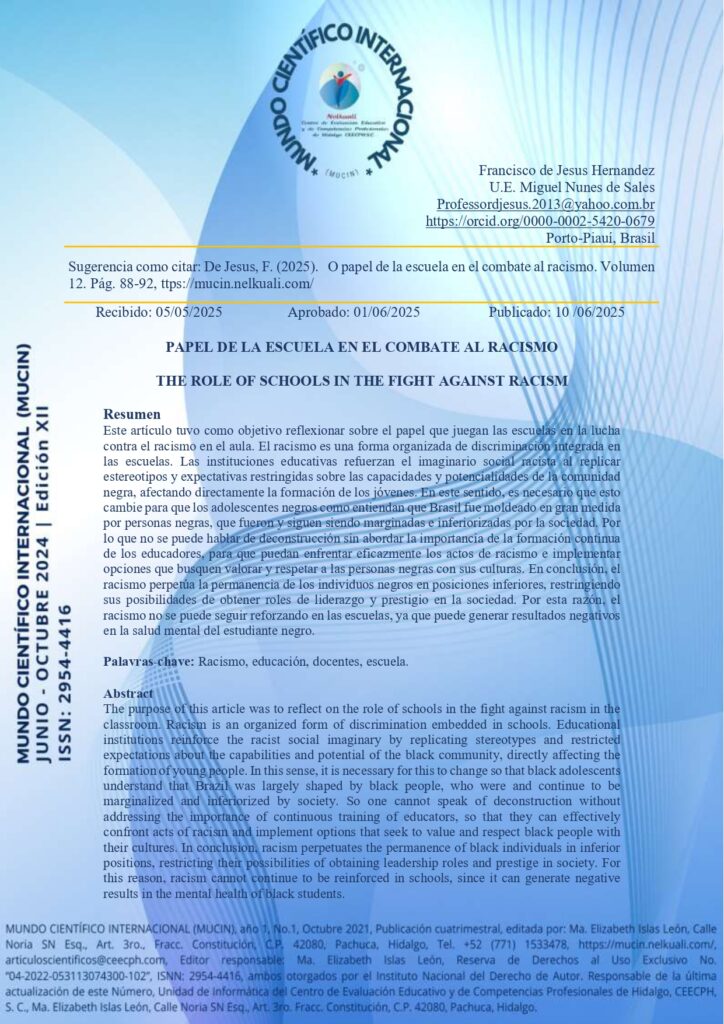
Este artículo tuvo como objetivo reflexionar sobre el papel que juegan las escuelas en la lucha contra el racismo en el aula. El racismo es una forma organizada de discriminación integrada en las escuelas. Las instituciones educativas refuerzan el imaginario social racista al replicar estereotipos y expectativas restringidas sobre las capacidades y potencialidades de la comunidad negra, afectando directamente la formación de los jóvenes. En este sentido, es necesario que esto cambie para que los adolescentes negros como entiendan que Brasil fue moldeado en gran medida por personas negras, que fueron y siguen siendo marginadas e inferiorizadas por la sociedad. Por lo que no se puede hablar de deconstrucción sin abordar la importancia de la formación continua de los educadores, para que puedan enfrentar eficazmente los actos de racismo e implementar opciones que busquen valorar y respetar a las personas negras con sus culturas. En conclusión, el racismo perpetúa la permanencia de los individuos negros en posiciones inferiores, restringiendo sus posibilidades de obtener roles de liderazgo y prestigio en la sociedad. Por esta razón, el racismo no se puede seguir reforzando en las escuelas, ya que puede generar resultados negativos en la salud mental del estudiante negro.
Palavras-chave: Racismo, educación, docentes, escuela.
Abstract
The purpose of this article was to reflect on the role of schools in the fight against racism in the classroom. Racism is an organized form of discrimination embedded in schools. Educational institutions reinforce the racist social imaginary by replicating stereotypes and restricted expectations about the capabilities and potential of the black community, directly affecting the formation of young people. In this sense, it is necessary for this to change so that black adolescents understand that Brazil was largely shaped by black people, who were and continue to be marginalized and inferiorized by society. So one cannot speak of deconstruction without addressing the importance of continuous training of educators, so that they can effectively confront acts of racism and implement options that seek to value and respect black people with their cultures. In conclusion, racism perpetuates the permanence of black individuals in inferior positions, restricting their possibilities of obtaining leadership roles and prestige in society. For this reason, racism cannot continue to be reinforced in schools, since it can generate negative results in the mental health of black students.
Palavras-chave: Racism, education, teachers, school.